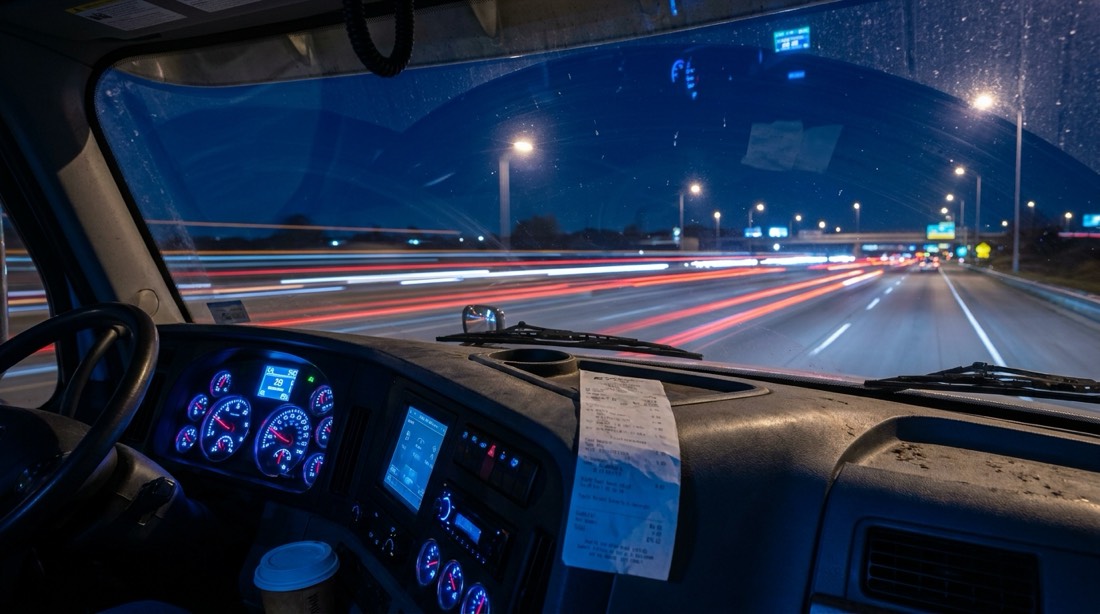
Ask ten drivers what a mile costs them and you'll get ten confident answers. Most of them are wrong — not because drivers can't do math, but because the number they're quoting was true three weeks ago. Maybe three months ago.
Your cost per mile isn't a number. It's a moving target — roughly half of it reprices while you sleep.
The half that sits still — and the half that never does
Your fixed costs are easy. Truck payment, trailer payment, insurance, plates, your own pay. They land on the same day every month, and you can split them across your miles with a napkin and a pen. At 94,000 miles a year, a typical owner-op runs about $1.20 a mile in fixed costs. That part of the math behaves.
The other half doesn't. Fuel reprices every single day — a 20-cent swing at the pump moves your cost 3 cents a mile overnight. Maintenance sits quiet for months, then one injector rewrites your whole quarter. Tires wear by the mile. Tolls and paid parking change route by route, and lots that were free last month aren't anymore.
The nickel that kills
Say your real cost is $2.26 a mile but you're pricing loads like it's $2.21. A nickel. Nothing, right? Run 94,000 miles on that nickel and you just donated $4,700 to the freight market. Off by a dime, that's $9,400. Off by a quarter — which happens the month after a big repair, every time — and you're down over $23,000 without one bad decision you could point to.
That's the trap: the leak never shows up on any one load. Every rate con looks fine. The money just isn't there at the end of the month, and you can't say where it went.
This is why 85% go under
85% of owner-operators go out of business in their first 24 months. Not because they can't drive — because they priced a year of loads off a number that stopped being true. Wrong number, bad bets, every day, compounding.
What keeping the number right actually takes
- Every fuel receipt, added up daily — because diesel changed price overnight
- Every repair bill, tow bill, and parts run, the day it happens
- Every toll, scale ticket, and paid parking spot — spread across cards and cash
- Every monthly bill, split across the miles you actually ran, not the miles you planned
- Every mile, loaded and empty, matched to the load that paid for it
Nobody does that by hand. Not after a 600-mile day. That's the honest reason most drivers run on a stale number — the bookkeeping required to keep it fresh is a second job nobody signed up for.
It's also exactly why Areva exists. She watches every fill-up, repair, and mile, and keeps your true cost per mile right — live, every single day. Know your number and every load gets simple: take it, push back, or walk away.