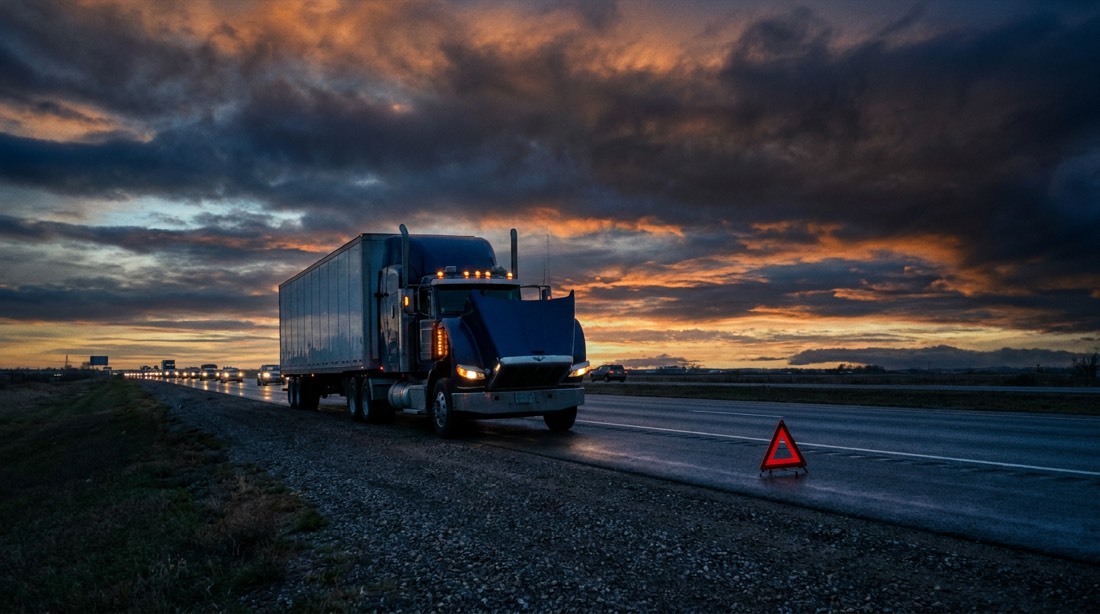
Two drivers lose the same water pump. One catches it early — a temp gauge creeping, a whine that wasn't there last week — and books a shop bay for Thursday. The other finds out on the shoulder of I-40 with a load on and a receiver waiting.
Same part. Same truck. One of them pays three to four times more. The bill breaks down like this.
The anatomy of a shoulder bill
- The tow — heavy-duty recovery starts steep and climbs by the mile. There is no shopping around from the shoulder.
- Roadside or emergency labor — you're paying whoever can come now, at whatever now costs.
- The parked day — your truck earns nothing while you wait. At typical owner-op numbers, a lost day is hundreds of dollars of revenue that never existed.
- The load — late fees, a re-power, or a burned relationship with a broker who remembers.
- The ripple — the next load you had lined up is gone, and the deadhead to replace it is on you.
Add it up and the pattern is brutal: the part is usually the cheap half of the bill. Everything wrapped around the part — the tow, the panic labor, the dead day — is what turns a $900 fix into a $3,500 hole.
Breakdowns rarely come from nowhere
Trucks talk before they quit. Oil pressure drifts. Coolant temp runs a few degrees hotter than it did all spring. A bearing hums at 62 that was silent at 55. The signals are there — the problem is that after ten hours of driving, nobody's cross-referencing today's gauge readings against last month's.
The cheapest repair is the one you scheduled
Head off two or three roadside failures a year and you've kept roughly $6,500 that would have gone to tows, emergency labor, and parked days. That's not new revenue — that's your own money, staying yours.
This is the job Areva does in the background: she listens to the truck's numbers every mile, learns what normal looks like for your rig, and flags the drift before it becomes a shoulder. The shop beats the shoulder every single time — the trick is getting the appointment before the truck makes it for you.