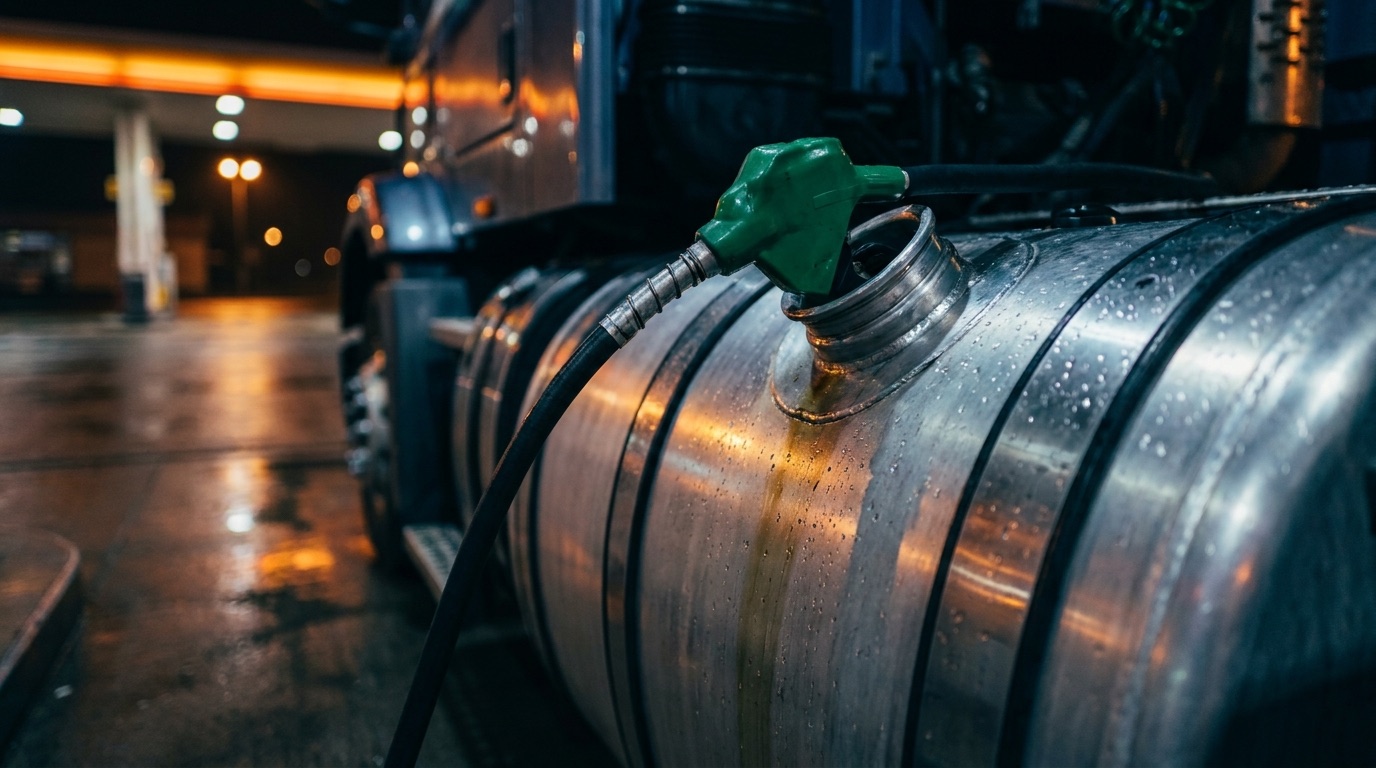
There's a stop two exits up that's forty cents cheaper than the one you just passed, and the needle's under a quarter. That feels like a decision. Chase it long enough and you'll build a whole route around it.
Most of that forty cents was never yours.
Diesel went through six dollars this month for the first time ever. The EIA's on-highway average hit $6.285 the week of September 14, up 31.8 cents in seven days and the highest figure they've ever recorded. A year ago the same number was $3.739. At six miles to the gallon that's 42 cents a mile of brand-new cost on a truck running the exact same lanes it ran last fall.
Which makes where you fill up feel like the biggest lever you've got left. It isn't. It's just the loudest.
You don't pay fuel tax where you buy it
That's the whole thing, and almost nobody gets told it plainly.
The price on the sign has that state's fuel tax baked into it. But if you're running interstate on an IFTA license, the tax doesn't stay where you handed it over. Every quarter you report two things: how many miles you ran in each state, and how many gallons you bought in each state. Each state then charges you its own rate on the gallons you burned inside its lines, and credits you for whatever tax you already paid at its pumps. Net it out and somebody writes a check.
So the tax half of that cheap sign isn't a discount. It's a float.
The fifty-four cent illusion
Pennsylvania charges 74.1 cents a gallon on diesel. Texas charges 20. Those are IFTA's own figures off the fourth-quarter 2026 tax matrix, and they're about as far apart as two states get.
So fill 150 gallons in Texas and run them out crossing Pennsylvania. The sign says you saved fifty-four cents a gallon. Call it eighty-one dollars. Then Pennsylvania counts the miles you ran inside its lines, works out the gallons that took, and bills you 74.1 cents on every one of them. You've got no Pennsylvania receipts to credit against, so you pay all of it.
You didn't save the tax. You moved it to late October.
A quarter of float is worth something, and I'm not going to pretend otherwise. But it isn't eighty-one dollars, and if you've been running your fuel strategy off the sign price, some of what you think is margin is sitting in a filing you haven't done yet. Third quarter closes September 30. It's due October 31, which is a Saturday this year, so November 2.
The number under the number
What you actually save is the part that isn't tax. The rack price, the network discount, whatever that truck stop decided to do this week. Pump price minus that state's tax rate is the only comparison that's real, and it's exactly why fuel cards and discount networks quote you a net number instead of the billboard.
Two stops that look forty cents apart on the sign can be within a nickel of each other underneath. Sometimes the ugly expensive-looking one is the cheaper fuel.
Where it leaks
- Receipts. The credit only exists if you can document it, and the requirements are fussy on purpose: date, the seller's name and address, fuel type, gallons, price per gallon, unit number. Lose the paperwork and you've paid that tax twice. Once at the pump with nothing to show for it, and again at filing.
- Surcharge states. Kentucky and Virginia stack a surcharge on top of the base rate that nobody collects at the pump. Ever. It's 4.5 cents in Kentucky and 15.3 in Virginia this quarter, and there's no such thing as prepaying it, so those miles cost more than any sign in either state will tell you.
- Filing late. Fifty dollars or ten percent of what you owe, whichever hurts more, plus interest.
- Your mileage records. Every number above starts with miles per state. If those are a guess, so is the return, and an audit is a bad place to learn that.
What actually moves
Fuel buying is still worth doing well. Compare net, carry a card that quotes net, and don't run the tank to fumes and leave yourself captive to whatever's at the next exit. On a good quarter that's maybe two or three cents a mile.
The rate is worth twenty times that, and it's the thing people negotiate least.
Diesel up $2.55 a gallon in twelve months is 42 cents a mile you have to recover from somewhere, and no fuel-buying strategy on earth finds 42 cents. It comes out of the rate or it comes out of you. And the surcharge on most rate cons is pegged to a national index and an assumed 6 mpg, which means it was already not covering it before this run-up started. That math is here.
So know your real number the week you're quoting, not three months later when the filing shows up. The cost calculator pulls the current diesel average straight from the government's own data, so your floor moves when the pump moves. I'd rather you look at that number and turn a load down than take it and find out in November.