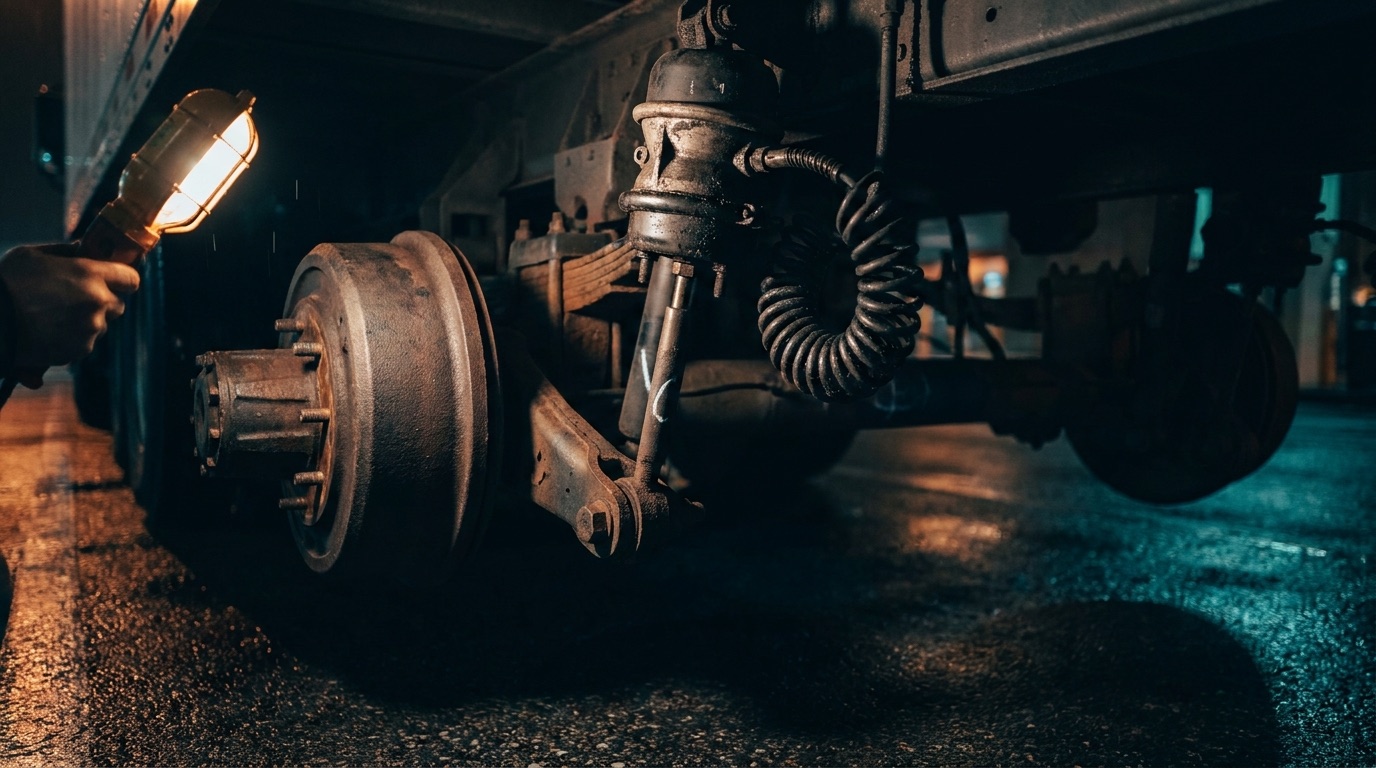
Brake Safety Week runs August 23 through 29 this year. For seven days, inspectors across the U.S., Canada and Mexico pull trucks in and go straight to the brakes. A truck that fails doesn't get a warning and a wave — it gets parked where it sits until somebody fixes it.
The part worth knowing is that it isn't really a special week. Brake violations are the most-cited out-of-service vehicle violation at the roadside every week of the year, out of roughly four million inspections a year. CVSA just picks seven days to count them out loud — and announces the dates in May.
Last year they inspected 15,175 trucks during the week. 2,296 went out of service for brakes — 15.1%. That cuts both ways: one in seven got parked, and 84.9% rolled out clean. It isn't a lottery. It's a maintenance check with a published date on it.
The rule that actually decides it
More than half of those out-of-service orders came down to one line in the criteria: 20% or more of the brakes on the combination are defective. That was 1,199 violations — 52.2% of every brake-related OOS written that week.
Run it on your own truck: a standard five-axle tractor-trailer has ten brakes, and twenty percent of ten is two. Two bad brakes out of ten and your day is over — and fractions round up, so the math never rounds in your favor.
"Defective" is broader than most people expect, and out of adjustment counts. A brake a quarter inch or more past its adjustment limit counts as a full defective brake; one between an eighth and a quarter inch past counts as half. So two brakes badly out plus two barely out isn't "a couple of little things" — it's three of ten, well over the line. Missing parts, an air leak, thin lining, grease on the friction surface — all defective, all counting.
What they're looking at this year
For the second year running, the focus is drums and rotors — and that isn't something you fix on the shoulder with a wrench. An external crack in a drum, a crack that opens when the brake is applied, or a missing piece that could break off — each is an out-of-service condition on its own, no 20% math required.
Last year's write-ups read like a to-do list. Of 113 drum and rotor violations, the biggest bucket was rusted rotor friction surfaces at 50, then broken drums at 32. Rust like that comes from a truck sitting, not running — so if yours has been parked through a soft stretch, that's what to look at before somebody else does.
What it actually costs
The repair is the cheap half. There are two versions of this bill, and the difference was never the parts:
- The day. The truck earns nothing until the defect is corrected, and you're fixing it wherever you sit, at whatever "right now" costs in that zip code.
- The load. Late or repowered — and the broker remembers which carrier that was.
- The CSA hit. A violation that draws an out-of-service order carries an extra severity weight of 2 in the Vehicle Maintenance BASIC, and anything from the last six months counts triple. One bad inspection follows you two years, heaviest at the start.
- The renewal. Your roadside record is part of the file an underwriter prices off of — the same file that sets your premium.
The pre-trip that pays for itself
- Chalk the pushrod travel at each chamber and know your limits by chamber type. Automatic slack adjusters go out of adjustment too — they just do it quietly.
- Listen for air. Build to pressure, shut it down, listen at each wheel with the brakes applied.
- Put a light on the drums and rotors. Cracks, missing chunks, a rotor that's more rust than metal.
- Check the hoses and tubes. Chafed, cracked, kinked — the second-biggest bucket last year at 306 violations.
- Fix small things on your schedule. A slack adjuster in your shop is a job. The same one on the shoulder of I-40 is a tow bill and a lost day.
Nobody should be adjusting brakes because of an enforcement calendar — you do it because a truck that stops well is the one asset you can't afford to have parked. But a week with a date on it is a fine excuse to get under the trailer with a light. And when you buy the drums, put the bill where it belongs: maintenance is the number owner-operators underestimate most, right until a $600 part becomes a $3,000 day. Run your real reserve through the cost calculator so it's in your rate floor before an inspector is in your mirror.